Hamstrings are not tight
Your Hamstring's are Not Tight!
Understanding The Positions That Create Tightness
"My hamstrings are tight and this is causing my back pain" is the most common phrase I hear. While I understand where people are coming from, this is only half right.
The first thing we have to define is the word tightness.
From science direct
"Muscle tightness is defined as a condition characterized by increased muscular tone, often resulting from a heightened rate of contraction stimulus or various stresses, leading to the muscles feeling tight and appearing shortened during evaluations. It is associated with limitations in range of motion and may cause pain or discomfort upon palpation or stretching."
Tightness is a feeling not a diagnosis. When you are testing a muscle for "tightness" this is usually in a rested state. This means the muscles are not contracting. While we do have a low tension all the time to stabilize the joints, this tension is to keep the length-tension at an "ideal position"
So how can muscles get tight then?
Muscles are controlled by the brain. The brain sends signals to the muscles, these muscles then begin to contract.
You are probably thinking how does this help. And that is what we will cover, why muscles feel tight when they aren't short.
Lets talk about what most providers say is tight. When someone says the muscle feels tight, they are doing one of two things. The first is they are palpating, meaning they are feeling the tone of the muscle. The second is testing passive range of motion.
Passive range of motion is how much someone else can move your joints.
This can show up as a limitation in range of motion, or the muscle feeling "ropey".
Side Note: I use this same language in my practice, but in my brain I am trying to figure out why the muscles is "Tight"
This all comes down to joint position, and how you manage gravity pushing down on you. Stretching will never increase the length of a "tight" muscle because in reality, the muscle is at a lengthened state already.
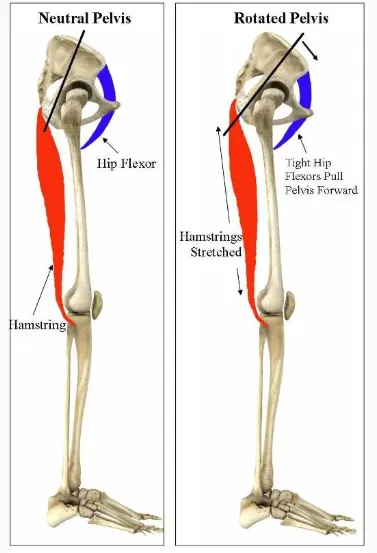
The hamstrings are the best example. They rely on the positioning of the pelvis and knee for the resting tension position.
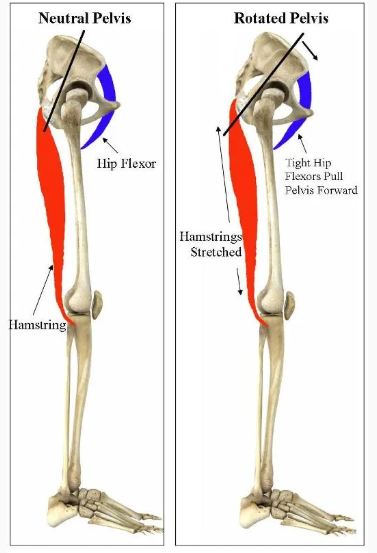
With an anterior pelvic tilt, the proximal part of the hamstring (insertion at the pelvis) is pulled away from the knee. Your brain know this is a lengthened position of the hamstring. Your brain will then put the brakes on, and say that it should not stretch any further. This is the sensation of tightness.
You may say, well it is because my hip flexors are short and tight. Yes to a degree, but again, you are missing that the position of the pelvis and how you manage gravity is the real key.
When our center of mass is pushed forward, you will immediately arch your low back, push through your toes, and straighten your knees.
The fix for hamstring "tightness" is not to stretch the hamstrings, it is to reposition the body to handle gravity better.
This is the same for the upper body. Your chest is not tight, you have lost the ability to use your breathing and internal pressures to fight gravity when you are standing. This is what causes the hunched over shoulders rounded position.
No amount of back strengthening will help this, it will actually make it worse, because now you are using the superficial muscles to hold yourself up instead of proper pressures created by breathing.
This is why your neck is tight, this is why your calves are tight, this is why everything FEELS tight.
It doesn't mean the muscles need to be stretched, it means that how you manage gravity has been impaired and you need to fix that first if you want long term results.
TLDR: stop stretching tight muscles and figure out how to reposition your body to restore proper length to the muscles.
