Why Your Back Keeps Hurting: Core Stability & Hip Control
Your Back Pain Might Not Actually Be a Back Problem
One of the most common things I see with people who have dealt with back pain for years is that their lower back is doing way more work than it needs to.
They've stretched, strengthened their core, gone to chiropractors, tried physical therapy, and maybe even gotten injections.
Some of those things help for a little while, but the pain keeps coming back.
One of the first things I look at with these patients is how well they can control their ribcage and pelvis.
Because if you can't control those two areas, your lower back often ends up picking up the slack.
Your Ribcage and Pelvis Matter More Than You Think
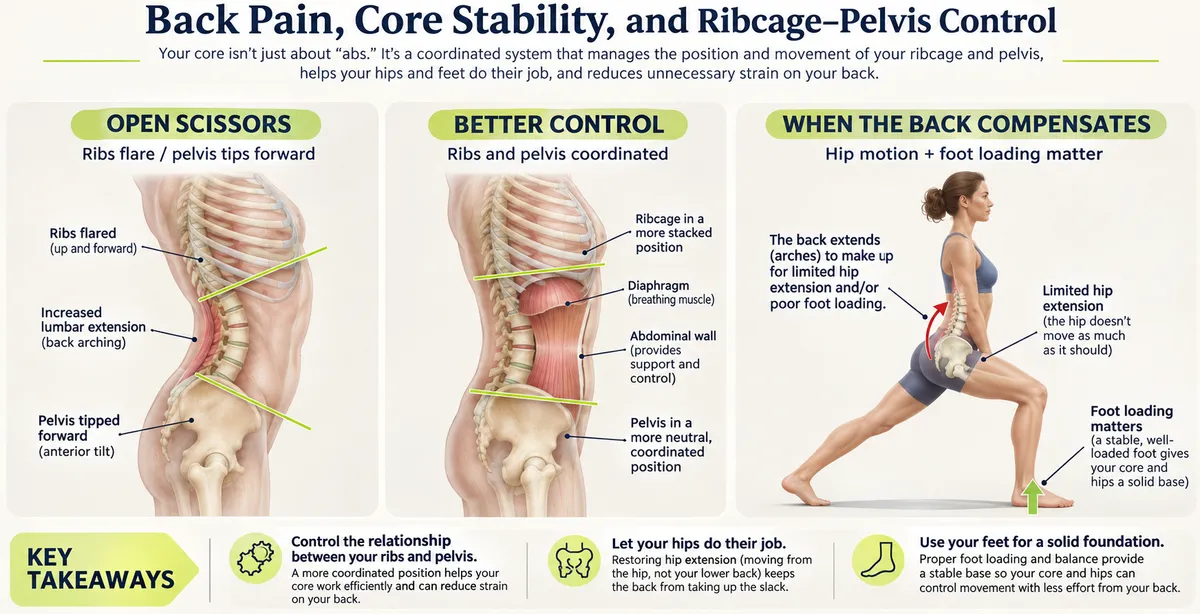
There's a position we commonly see called an open scissors position.
Basically, your ribs are flared up, your pelvis is tipped forward, and your lower back is arched.
Now, there's nothing inherently wrong with being in this position. The problem comes when you can't get out of it or control it when you're moving.
Your core isn't just your six-pack muscles. It's a system of muscles that work together to help you breathe, create pressure, and control movement.
When your ribcage and pelvis aren't working well together, you may have a harder time using that system effectively.
Instead, you start relying on the muscles in your lower back to create stability.
Those muscles are supposed to work, but they shouldn't have to do everything.
And if you're constantly using your lower back to hold yourself up or create movement, it's not surprising that it may start feeling tired, tight, or irritated.
Your Hips Might Be Making Your Back Work Harder
Here's an example I see all the time.
When you walk, your leg needs to travel behind your body. That's called hip extension.
Ideally, that movement comes primarily from your hip.
But what happens when you can't extend your hip without moving your pelvis?
You arch your lower back to make up the difference.
Your body still accomplishes the task, but it uses a different strategy to get there.
Now think about how many steps you take every day.
If your lower back is repeatedly helping create movement that should be coming from your hip, that's a lot of extra work.
The same thing can happen when you're lifting weights, running, or swinging a golf club.
This is why I spend so much time looking at how someone moves rather than just focusing on where they hurt.
Don't Forget About Your Feet
Something else that gets overlooked is how you're loading your feet.
Your feet are the only connection you have to the ground when you're standing, walking, or squatting.
If you can't control where your weight goes through your feet, your body has to make adjustments farther up the chain.
That might mean changing how your knees move, rotating through your hips differently, or using your lower back to help keep your balance.
Again, your body is really good at finding a way to accomplish a task.
But just because you can complete a movement doesn't mean you're using the best strategy available to you.
And over time, those compensations may contribute to the discomfort you're experiencing.
So How Do We Actually Fix This?
This is where I think a lot of people get frustrated.
They've been told to strengthen their core, so they do planks.
Their hips feel tight, so they stretch their hip flexors.
Their back hurts, so they stretch their back.
But none of that necessarily changes how they're moving.
What I want to see is whether you can control your ribcage and pelvis while moving your arms and legs.
Can you extend your hip without arching your back?
Can you shift your weight through your feet without losing control of your pelvis?
Can you maintain that control when we start adding strength exercises?
That's where we start.
First, we work on improving your ability to control different positions. Then we build movement through your hips and feet. Finally, we load those movements so you can actually use them in everyday life.
And to be clear, the goal isn't to walk around with your ribs tucked down and your abs tight all day.
The goal is to have enough control and strength that your body doesn't have to rely on the same compensations every time you move.
Stop Focusing Only on Where It Hurts
If you've been dealing with back pain for months or years, there's a good chance you've spent a lot of time trying to make your back feel better.
And while not every case of back pain is caused by movement compensations, they're something I think is worth investigating when the same problem keeps coming back.
At Kalamazoo Chiropractic & Rehabilitation, we don't just look at the area that's painful.
We look at how your entire body moves, where you may be compensating, and what needs to improve so you can get back to doing the things you enjoy.
Because at the end of the day, I don't just want you to have less back pain.
I want you to be able to lift weights, play golf, run around with your kids, and stay active without constantly worrying about your back.
If your back pain keeps coming back and you're tired of chasing temporary relief, schedule a free Discovery Consultation. We'll talk about what's going on and whether our approach makes sense for you.
